Discover Thoothukudi District
Thoothukudi District, popularly known as the Pearl City of Tamil Nadu, is one of the state’s most vibrant coastal districts, renowned for its rich maritime heritage, thriving industries, historic monuments, and diverse natural landscapes. Situated along the southeastern coast of Tamil Nadu on the shores of the Gulf of Mannar, the district serves as a major gateway for international trade through the V.O. Chidambaranar Port, one of India’s largest and busiest ports.
Established as a separate district in 1986, Thoothukudi has evolved into an important center for commerce, fisheries, salt production, renewable energy, education, and tourism. The district is home to pristine beaches, ancient temples, magnificent churches, bustling fishing harbors, salt pans, wind farms, wildlife habitats, and culturally significant heritage sites that attract visitors throughout the year.Agriculture and fisheries continue to be the backbone of the rural economy, while industries such as shipping, logistics, chemicals, thermal power, seafood processing, and renewable energy contribute significantly to the district’s economic growth. Thoothukudi is also internationally recognized for its pearl fishing history, earning it the title “Pearl City.With a harmonious blend of tradition and modern development, Thoothukudi offers visitors an unforgettable experience through its scenic coastline, spiritual destinations, vibrant festivals, delicious seafood .
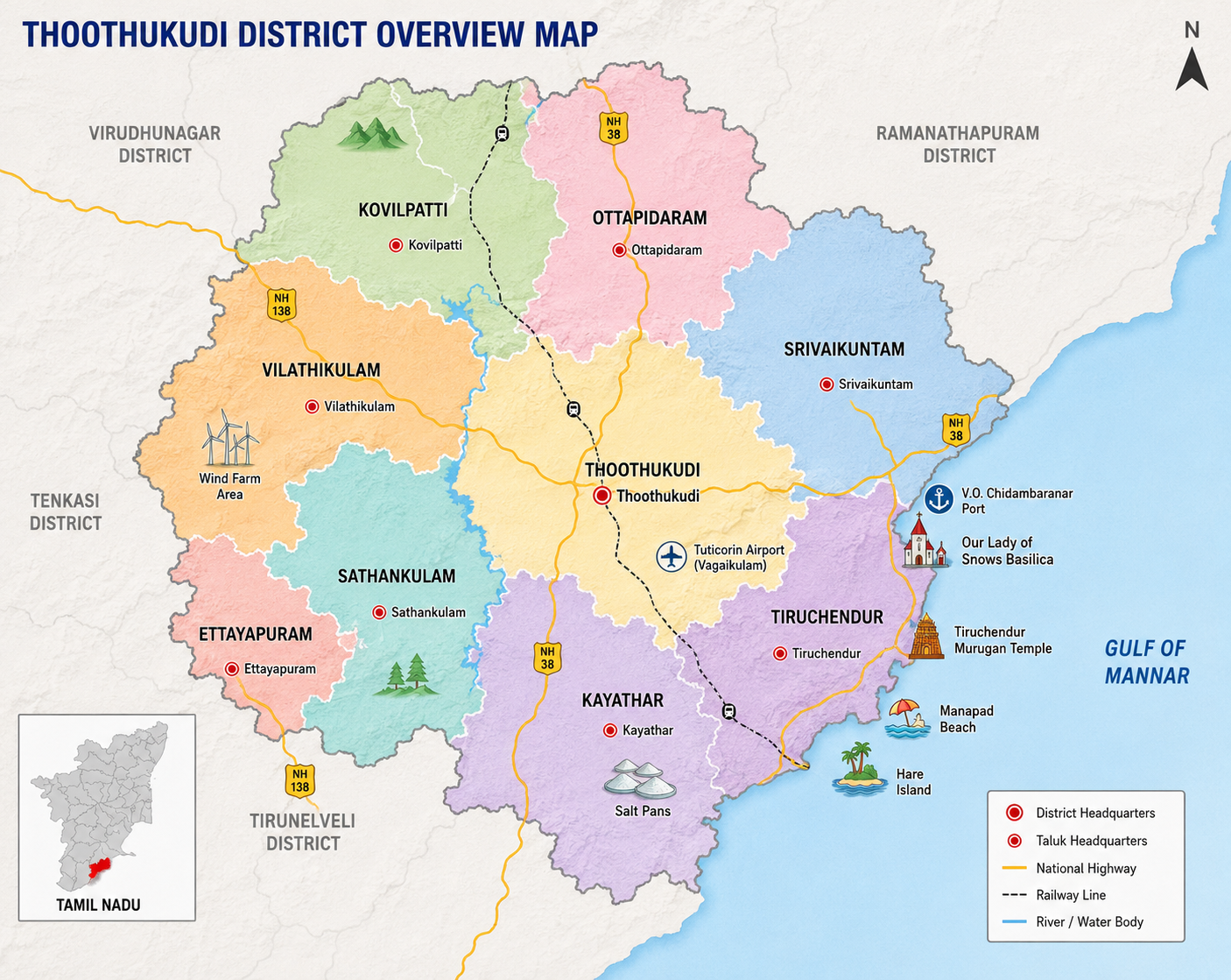
Top Citys in Thoothukudi
Pearl City of Tamil Nadu
Thoothukudi, the district headquarters, is the economic and administrative heart of Thoothukudi District. Situated along the Gulf of Mannar, the city is internationally recognized for its historic pearl fishing industry, thriving seaport, salt production, fisheries, and rapidly growing industrial sector. Home to the V.O. Chidambaranar Port, one of India’s major ports, Thoothukudi plays a vital role in international trade and logistics. The city also boasts beautiful beaches, historic churches, educational institutions, and modern infrastructure, making it one of the fastest-growing coastal cities in South India.
⭐ Famous For
Port & Shipping, Pearl Fishing, Salt Production, Fisheries, Industries
📊 Area
Approximately 90 sq. km
👥 Population
Approximately 4.2 Lakhs
Sacred Coastal Pilgrimage Town
Tiruchendur is one of Tamil Nadu’s most revered spiritual destinations and is famous for the Arulmigu Subramanya Swamy Temple, one of the six sacred abodes of Lord Murugan. Located along the Bay of Bengal, the town attracts millions of devotees every year. Apart from its religious significance, Tiruchendur is known for its serene beaches, cultural heritage, vibrant festivals, and coastal beauty, making it one of the district’s most visited tourist destinations.
⭐ Famous For
Murugan Temple, Pilgrimage Tourism, Beaches, Festivals
📊 Area
Approximately 33 sq. km
👥 Population
Approximately 38,000
Match & Sweet Manufacturing Hub
Kovilpatti is one of the largest commercial towns in southern Tamil Nadu and serves as an important industrial and business center. The town is widely known for its world-famous Kovilpatti Kadalai Mittai (Peanut Candy), match industries, textile trading, and educational institutions. Excellent road and rail connectivity have transformed Kovilpatti into a major commercial gateway for the western region of the district.
⭐ Famous For
Murugan Temple, Pilgrimage Tourism, Beaches, Festivals
📊 Area
Approximately 50 sq. km
👥 Population
Approximately 1.1 Lakhs
Heritage Town on the Thamirabarani
Srivaikuntam is a historic town situated on the banks of the Thamirabarani River. It is renowned for the ancient Sri Vaikuntanatha Perumal Temple, one of the famous Nava Tirupati temples dedicated to Lord Vishnu. The fertile river basin supports extensive agriculture, while the town’s heritage, temples, and traditional culture make it an important destination in the district.
⭐ Famous For
Vaikuntanatha Temple, Agriculture, Heritage, Thamirabarani River
📊 Area
Approximately 25 sq. km
👥 Population
Approximately 20,000
Birthplace of Mahakavi Bharathiyar
Ettayapuram is celebrated as the birthplace of Mahakavi Subramania Bharathiyar, one of India’s greatest poets and freedom fighters. The town preserves its rich literary heritage through the Bharathiyar Memorial House and various cultural landmarks. Ettayapuram also has historical significance due to the Ettayapuram Zamindari and is surrounded by agricultural landscapes and traditional villages.
⭐ Famous For
Mahakavi Bharathiyar, Literary Heritage, Historical Palace, Agriculture
📊 Area
Approximately 18 sq. km
👥 Population
Approximately 16,000
Population Statistics of Thoothukudi District
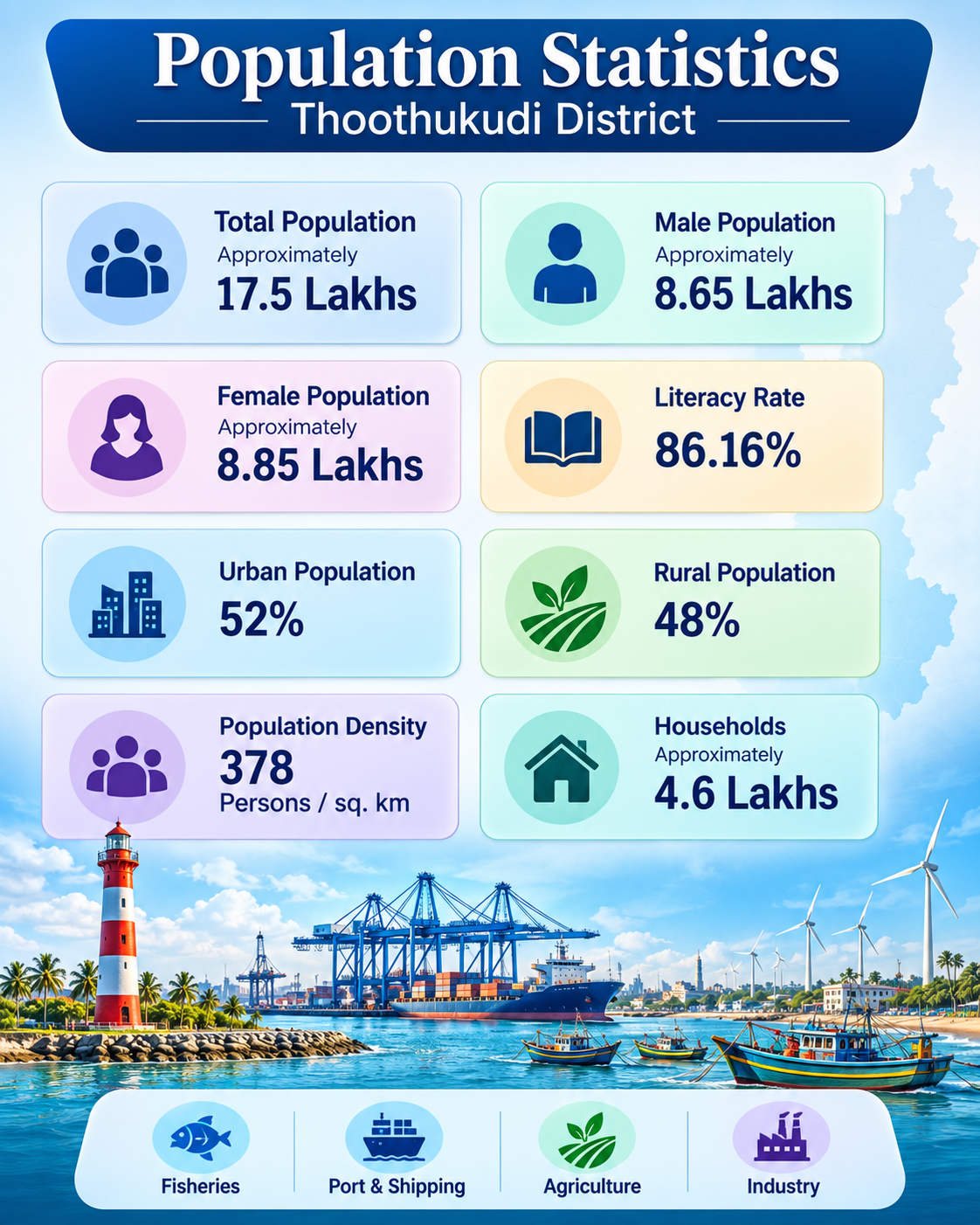
Thoothukudi District is home to a vibrant and diverse population of approximately 1.75 million people. The district has experienced steady growth due to its strategic location, industrial development, expanding port activities, and strong agricultural economy. As one of Tamil Nadu’s important coastal districts, Thoothukudi maintains a balanced mix of urban and rural communities, contributing to its cultural richness and economic strength.
The district demonstrates encouraging social development indicators, including a high literacy rate and improving access to education, healthcare, and public infrastructure. Urban centers such as Thoothukudi, Kovilpatti, and Tiruchendur serve as major hubs for commerce, education, and employment, while the surrounding rural regions continue to thrive through agriculture, fisheries, salt production, and allied industries.
With a favorable gender ratio, expanding urbanization, and continuous investments in infrastructure and public services, Thoothukudi District continues to progress as one of southern Tamil Nadu’s most dynamic and economically significant districts.
Key Population Highlights
- Total Population: Approximately 17.5 Lakhs
- Male Population: Approximately 8.65 Lakhs
- Female Population: Approximately 8.85 Lakhs
- Population Density: 378 persons per sq. km
- Literacy Rate: 86.16%
- Urban Population: 52%
- Rural Population: 48%
- Primary Occupations: Fisheries, Agriculture, Port & Shipping, Salt Production, Manufacturing, Trade, and Services.
Area measurements of Thoothukudi District
Thoothukudi District is one of Tamil Nadu’s most geographically diverse regions, offering a unique combination of coastal plains, fertile river basins, dry inland landscapes, and ecologically significant marine environments. Located along the southeastern coast of India, the district enjoys a strategic position on the shores of the Gulf of Mannar, making it an important centre for maritime trade, fisheries, and coastal tourism.
The district’s varied terrain supports a wide range of economic activities. Fertile agricultural lands nourished by the Thamirabarani River produce paddy, pulses, cotton, millets, and horticultural crops, while the extensive coastline sustains one of India’s largest fishing communities. The coastal belt is also internationally known for its pearl fishing heritage and expansive salt pans, which have contributed to the district’s economy for centuries.
Beyond its economic importance, Thoothukudi possesses remarkable environmental value. The district forms part of the Gulf of Mannar Biosphere Reserve, India’s first marine biosphere reserve, which protects coral reefs, seagrass meadows, mangroves, and numerous endangered marine species. This ecological richness makes the district a significant destination for marine conservation and eco-tourism.
The geographical diversity of Thoothukudi also supports rapid industrial and infrastructure development. Its modern seaport, national highways, railway connectivity, airport, and renewable energy resources have transformed the district into one of southern India’s leading industrial and logistics hubs while maintaining a balance between economic growth and environmental sustainability.
Strategically located along the Gulf of Mannar on the southeastern coast of Tamil Nadu.
Features a diverse landscape of coastal plains, agricultural fields, inland dry zones, and marine ecosystems.
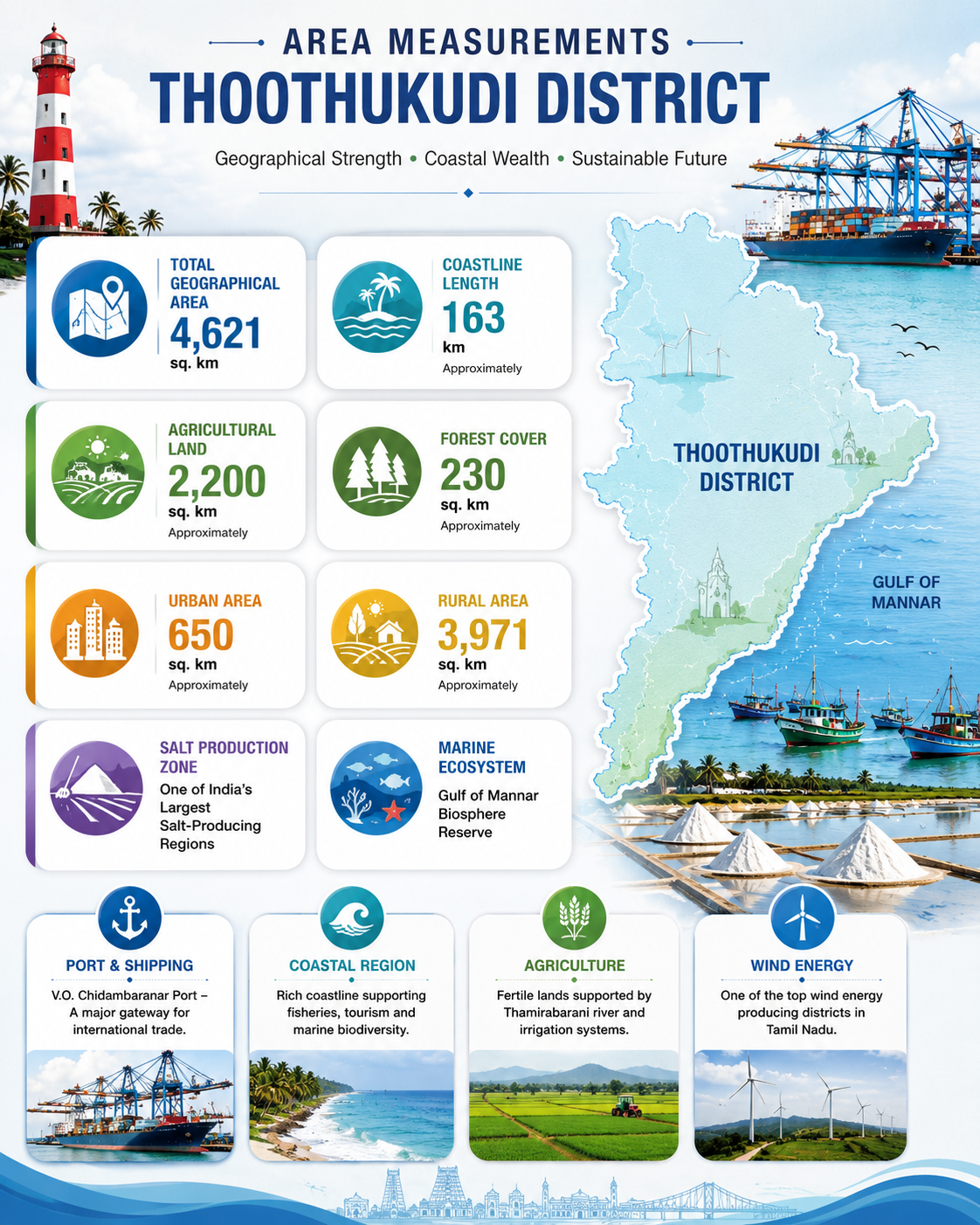
| Measurement | Details |
|---|---|
| 📍 District Headquarters | Thoothukudi |
| 🗺 Total Geographical Area | 4,621 sq. km |
| 🌊 Coastline Length | Approximately 163 km |
| 🏞 Major River | Thamirabarani River |
| 🌿 Forest Cover | Approximately 230 sq. km |
| 🌾 Agricultural Land | Approximately 2,200 sq. km |
| 🏙 Urban Area | Approximately 650 sq. km |
| 🌱 Rural Area | Approximately 3,971 sq. km |
| 🏛 Administrative Taluks | 9 |
| 🏘 Revenue Villages | 400+ |
| 🌍 Biosphere Reserve | Gulf of Mannar Biosphere Reserve |
| ⚓ Major Port | V.O. Chidambaranar Port |
| ✈ Airport | Tuticorin Airport (Vagaikulam) |
| 🌬 Renewable Energy | Major Wind Energy Corridor |
| 🧂 Salt Production | One of India’s Largest Salt-Producing Districts |
Historical Background of Thoothukudi District
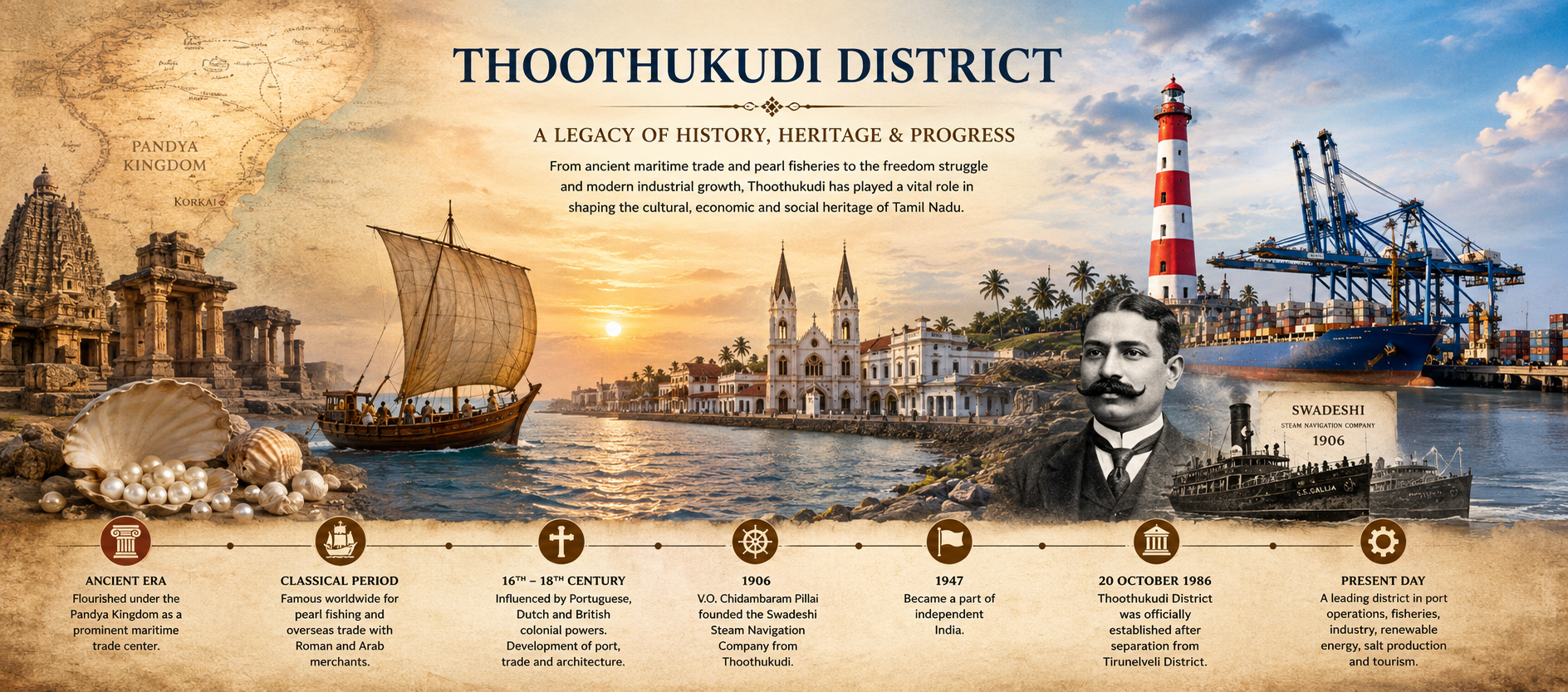
Thoothukudi District possesses a rich and fascinating history that spans over two thousand years, making it one of the oldest maritime regions in South India. Historically known as Tuticorin, the district has long been recognized as an important center for maritime trade, pearl fishing, and cultural exchange. Its strategic location along the Gulf of Mannar enabled thriving trade with ancient civilizations, including the Romans, Greeks, Arabs, and Southeast Asian kingdoms.
During the Pandya dynasty, Thoothukudi flourished as a major coastal trading port, exporting pearls, spices, textiles, and other valuable goods. The district became internationally renowned for its pearl fisheries, earning the title “Pearl City of Tamil Nadu.” The abundant marine resources of the Gulf of Mannar played a vital role in shaping the district’s economy and cultural heritage.
From the 16th century onward, Thoothukudi witnessed the arrival of European colonial powers, including the Portuguese, Dutch, and British. Each contributed to the development of the port, trade infrastructure, and architecture. Historic churches such as the Our Lady of Snows Basilica stand today as enduring symbols of this colonial influence and the district’s multicultural legacy.
The district also played a significant role in India’s freedom movement. Freedom fighter V.O. Chidambaram Pillai, affectionately known as Kappalottiya Tamilan, launched the Swadeshi Steam Navigation Company from Thoothukudi in 1906 to challenge British maritime dominance. His efforts inspired the Swadeshi movement and remain a proud chapter in India’s struggle for independence.
Following Independence, Thoothukudi experienced rapid industrial and economic growth. The establishment of the V.O. Chidambaranar Port, expansion of fisheries, salt production, thermal power generation, chemical industries, and logistics transformed the district into one of Tamil Nadu’s leading industrial and commercial hubs. Recognizing its administrative importance, Thoothukudi District was officially formed on 20 October 1986, after being carved out of the former Tirunelveli District.
Revenue Administration
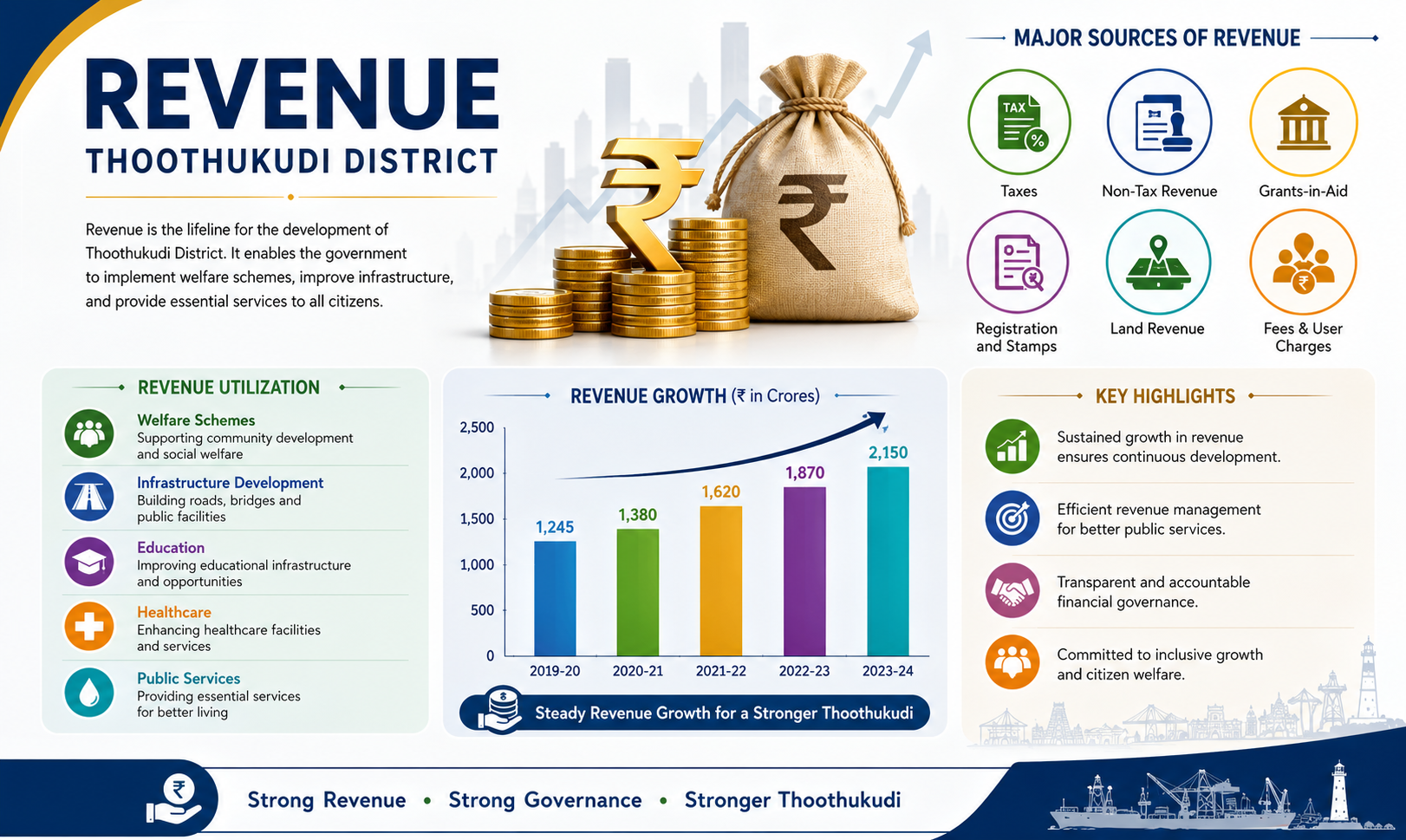
Efficient Governance for Inclusive Development
The Revenue Administration of Thoothukudi District plays a vital role in ensuring effective governance, land management, disaster response, and the delivery of essential public services. Operating under the guidance of the District Collector, the Revenue Department serves as the backbone of the district administration by implementing government policies and maintaining law and order through a well-organized administrative structure.
The district is divided into Revenue Divisions, Taluks, Firkas, and Revenue Villages, enabling efficient governance and easy access to public services. Revenue officials oversee land records, issue statutory certificates, coordinate relief during natural disasters, conduct elections, and implement various welfare schemes to improve the quality of life for residents.
In recent years, the department has embraced digital governance by offering online services for certificates, land records, tax payments, and grievance redressal, making public services more transparent, accessible, and citizen-friendly.